
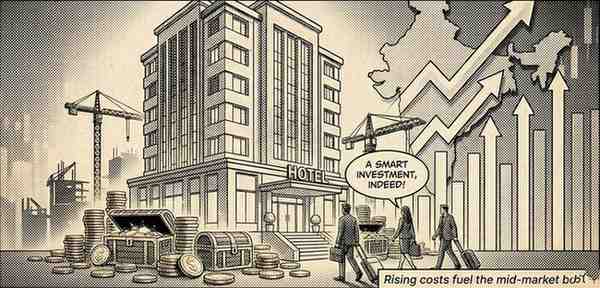
New Delhi, February 2026 — The era of glittering five-star dominance in Indian hospitality is facing a reality check. While the nation celebrates a record-breaking year for hotel signings, a new report by HVS ANAROCK and Gleeds Consulting reveals a pivot in the industry: the real goldmine isn’t in luxury penthouses, but in the mid-scale hotels rising across Tier 2 and Tier 3 cities.
The Death of the “Luxury-Only” Narrative
For decades, the Indian hotel boom was synonymous with ultra-luxury palaces and Mumbai skyscrapers. However, 2025 marked a structural shift. While India hit a milestone with 6,220 new hotel keys signed, the “Economy” segment is shrinking—dropping from 6% to just 3% of the future pipeline.
In its place, the Mid-Scale segment has become the industry darling. It now accounts for 37% of total supply and a commanding 39% of all upcoming projects. This isn’t just a trend; it’s a calculated move by developers to align with India’s domestic travel reality: business trips, regional corporate activity, and pilgrimages.
The Math Behind the Shift: Construction Costs Explode
The pivot to mid-scale is driven by a brutal financial reality: building a hotel in India has never been more expensive. In 2025 alone, development costs rose by 8% to 12% due to material inflation and labor shortages.
The “per-key” cost (excluding land) illustrates why developers are fleeing the luxury tier:
- Mid-Scale (4-Star): ₹48 lakh – ₹69 lakh per room.
- Upper Up-Scale: ₹1.13 crore – ₹1.82 crore per room.
- Luxury: ₹1.93 crore – ₹3.71 crore per room.
With luxury rooms costing nearly five times more to build than mid-scale ones, the “return on investment” equation has broken for many premium projects, especially as land values in metros like Delhi and Mumbai skyrocket.
The Rise of the “Silent” Markets
As Tier 1 cities become “harder to work with,” the geography of Indian hospitality is widening. Growth is no longer concentrated in the Big Six. Instead, the “New India” is being built in:
- Tier 2 Cities: Pune, Ahmedabad, Jaipur, Kochi, and Lucknow.
- Tier 3 Cities: Indore, Bhubaneswar, Coimbatore, Nagpur, and Surat.
In these markets, lower land costs and improved infrastructure allow for faster stabilization. Developers are finding that a well-placed mid-scale hotel in Indore often offers better margins than a luxury project in a saturated metro.
Bottom Line: A Calibrated Future
India is on track to reach 350,400 branded rooms by 2030, but the nature of that growth is now “aspirational yet affordable.” The glitz of luxury is being replaced by the efficiency of mid-scale. As Akash Datta of HVS ANAROCK notes, the future belongs to those who can control capital deployment while capturing the massive middle-income domestic traveler. The “Hotel Boom” is still alive—it’s just moving to the neighborhood next door.
Leave a Reply