
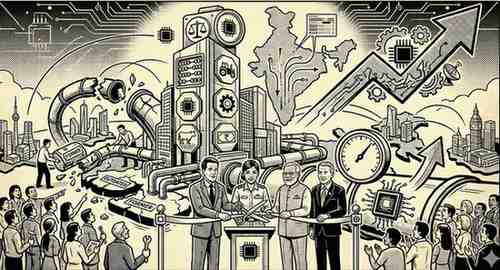
NEW DELHI, March 1, 2026 — India has officially revamped its economic reporting framework, introducing a sweeping set of changes to how Gross Domestic Product (GDP) is calculated. While the third-quarter growth for FY26 is pegged at 7.8%, the real story lies in the “engine” behind these numbers. Policymakers and international bodies have long debated the accuracy of India’s data; now, a new methodology aims to align the nation with global standards.
Modernizing the “Base Year”: Capturing the Digital Shift
The most significant change is the shift of the “Base Year” from 2011-12 to 2022-23. For a decade, India used data from a pre-UPI, pre-digital-boom era. The new benchmark captures the “new normal” of the post-COVID economy, including the massive expansion of digital services and the shift in household consumption patterns.
International organizations like the IMF had previously flagged discrepancies in India’s old methodology, even assigning a “C grade” in certain reports. This update is a direct move to restore global investor trust by ensuring that the goods and services produced today—which didn’t exist in 2011—are finally counted accurately.
The Move to “Double Deflation”
To ensure more precise results, India is moving from a “single deflation” method to “double deflation” for sectors like manufacturing and agriculture.
- The Old Way: Only the prices of the final output were adjusted for inflation.
- The New Way: Both the output prices and the costs of raw materials (inputs) are separately adjusted for inflation.
This prevents “artificial” growth numbers. For instance, if raw material prices rise faster than final product prices, the “double deflation” method provides a more accurate—and sometimes lower—view of the actual value added to the economy, reflecting the true health of the manufacturing sector.
High-Frequency Data: Tracking the Informal Economy
The overhaul also replaces old, infrequent surveys with “High-Frequency Indicators”. By integrating real-time data from GST filings, the Ministry of Corporate Affairs (MCA), and digital payment systems, the government can now better track:
- Gig Workers and Self-Employed Individuals: Capturing segments of the economy that were previously estimated through “proxy” methods.
- Government Spending: Utilizing the Public Financial Management System (PFMS) to track actual fund disbursement rather than broad budgetary estimates.
A Shift in Spending Habits
The new data also reflects a dramatic shift in how Indians spend their money. The weightage of food in the Consumer Price Index (CPI) has dropped from 45% to approximately 37%. This indicates that as the economy matures, households are spending more on services, technology, and travel rather than just basic sustenance.
Bottom Line
These changes do not necessarily mean India has suddenly become “richer” overnight; rather, they mean the “masks are off” regarding old estimation errors. By adopting more rigorous tracking, India aims to provide the “moral clarity” needed for effective policy-making. As the nation eyes its “Viksit Bharat” goals, these refined metrics will be the yardstick by which real progress—and the impact of every rupee spent—is measured.
Leave a Reply