
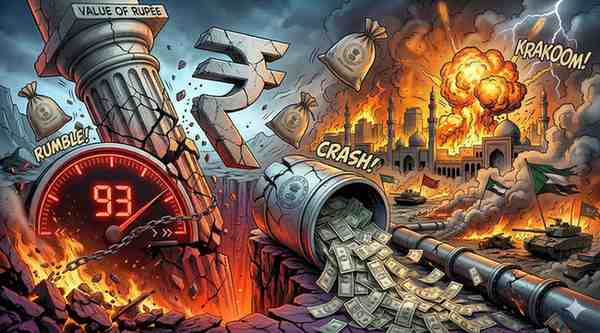
MUMBAI, March 23, 2026 — The Indian Rupee plummeted to a historic intraday low of 93.08 against the US Dollar this Friday, marking a significant psychological and economic breakdown. As the conflict in the Middle East intensifies, the currency has declined 2.3% in mere weeks, exposing the fragility of a nation heavily tethered to global energy imports.
The Oil and Gas “Tax”
The primary driver of the Rupee’s freefall is India’s massive import bill. With the country importing over 90% of its crude oil—half of which flows from the now-volatile Gulf States—every spike in global oil and gas prices acts as a direct drain on the national treasury.
India is now forced to “shell out more rupees” for every barrel of oil and gram of gold it brings across its borders. This surge in import costs has effectively exposed a structural vulnerability: India’s energy security is at the mercy of a battlefield thousands of miles away.
The FPI Exodus: Flight to Safety
Foreign Portfolio Investors (FPIs) are abandoning Indian markets in favor of “safe-haven” assets like gold and US-backed securities. After a brief period of buying in February, the tide has turned into a massive outflow:
- The Scale: In the first 15 days of March alone, FPIs withdrew a staggering $5.7 billion from the Indian economy.
- The Motive: In times of war, institutional money prioritizes capital preservation over emerging market growth, leaving the Indian markets struggling for liquidity.
The RBI’s $20 Billion Battle
The Reserve Bank of India (RBI) is currently locked in a desperate defensive maneuver to prop up the currency and manage government borrowing costs. To date, the central bank has burned through more than $20 billion in foreign exchange reserves to arrest the Rupee’s descent.
Beyond direct currency intervention, the RBI has undertaken record government bond purchases, injecting ₹1 trillion (approx. $10.7 billion) into the system this month alone to support the fixed-income market. Despite these efforts, the 10-year bond yield has climbed nearly 2 percentage points this year, signaling deep-seated market anxiety.
A War Fought on Balance Sheets
The conflict in the Strait of Hormuz has evolved into a sophisticated currency war. As Iran attempts to bypass Western sanctions by pitching the Chinese Yuan against the US Dollar, the Indian Rupee has become one of the most exposed casualties in the crossfire.
The challenges for the RBI are now four-fold: managing a surging import bill, controlling inflation, stemming capital outflows, and preventing a runaway trade deficit.
Bottom Line
The era of “stable” emerging market growth has been interrupted by a brutal geopolitical reality. With the Rupee breaching 93, the masks are off: India’s economic resilience is being tested by its dependence on imported energy. As the RBI drains its reserves to fight a fire it didn’t start, the question remains how long the nation can afford to shell out more for its basic needs while its capital flies to safer shores.
Leave a Reply