
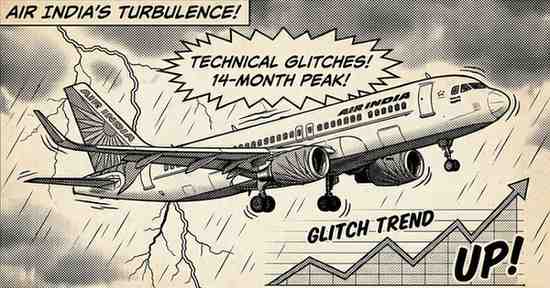
New Delhi, February 2026 — Air India’s ambitious journey to reclaim its status as a world-class carrier has hit a significant roadblock. New data reveals that technical failures—ranging from engine leaks to hydraulic glitches—surged to a 14-month high in January 2026, leaving the Tata Group-owned airline facing a crisis of confidence.
The Data: A Four-Fold Increase in Failures
While Air India continues its sweeping “Vihaan.AI” transformation plan, internal documents reviewed by Reuters paint a starkly different picture of the airline’s operational health. In January 2026, the carrier recorded 1.09 technical incidents per 1,000 flights, a massive jump from the 0.26 rate reported in December 2024.
Across more than 17,500 flights operated in a single month, the airline logged 23 major technical incidents. These were not minor delays; they included:
- Engine oil and fuel leaks that forced emergency protocols.
- Hydraulic failures and flight control glitches.
- Engine stall warnings that triggered formal investigations in 21 out of 23 cases.
82% of the Fleet Under the Scanner
The reliability gap becomes even more glaring when compared to domestic rivals. Data presented in Parliament shows that 82.5% of Air India’s 166 aircraft analyzed since January 2025 have reported recurring technical defects. In contrast, market leader IndiGo reported recurring issues in only 36.5% of its fleet. One Dubai-to-Mumbai flight recently landed with critically low engine oil, highlighting the narrow margins for error currently facing the crew.
The “16-Hour Nightmare”: Broken Seats and $22 Vouchers
The technical data is being mirrored by a wave of passenger outrage on social media. Naim O’Donnell, an executive at Silicon Valley’s Unusual Ventures, recently went viral after detailing her “nightmare” 16-hour journey from Delhi to San Francisco.
Her flight was abruptly rescheduled with an unannounced layover in Korea, only for her to find her in-flight entertainment (IFE) system broken for the entire trans-Pacific duration. Adding insult to injury, O’Donnell claimed Air India offered a mere ₹2,000 (roughly $22) as compensation for the disruption. This sparked a cascade of “me too” stories from passengers reporting broken seats, non-functional screens, and decaying cabin interiors on flagship international routes.
Safety Oversight and Geopolitical Strain
The airline remains under “heightened scrutiny” from India’s aviation regulator following last year’s tragic crash that claimed 260 lives. Despite admitting that urgent improvements are needed in “process discipline and communication,” the airline is also battling external pressures. The closure of Pakistani airspace to Indian carriers has forced expensive route adjustments, adding financial weight to an already strained operation.
Bottom Line
Air India’s revival was supposed to be a story of Indian corporate pride. However, with technical snags hitting record highs and a fleet struggling with basic maintenance, the airline finds itself at a crossroads. As it seeks to expand its global footprint, the message from the skies is clear: flashy branding and new aircraft orders mean little if the planes currently in the air cannot guarantee a seamless, safe journey.
Leave a Reply