
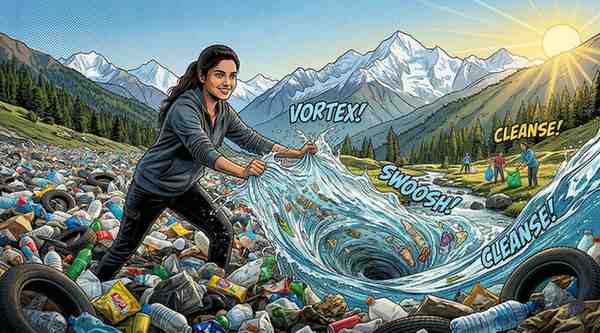
Sangti Valley, March 2026 — In the remote, fragile ecosystems of the Himalayas, where five to eight million metric tons of waste are generated annually, the land was never built to carry the burden of modern plastic. While metropolitan cities have seen major waste management overhauls, the North East has largely been left behind—until now.
Ittisha Sarah, founder of the North East Waste Collective, walked away from a corporate career in New Delhi to return to her homeland and build a defense against environmental decay in the Sangti Valley.
From Delhi Corporate to Himalayan Conservation
Home to around 1,500 members of the Monpa tribe, the Sangti Valley initially had zero infrastructure for waste management. “People thought that garbage should be thrown into the river,” Sarah explains, noting that this was the traditional, albeit destructive, method of “cleaning” the village.
The transition wasn’t just logistical; it was social. Initially, villagers were suspicious of her motives, questioning why an outsider—even one from the region—would return just to pick up trash. Some even assumed she was being paid exorbitant sums by external agencies to do so.
The “Lunar” Cleanup Model: Community as the Foundation
To overcome skepticism, Sarah centered her system on community ownership. The village is now divided into five colonies, and every household contributes one member for a mandatory monthly social service day. This cleanup occurs on the 8th day of the lunar calendar, ensuring the practice is woven into the cultural and spiritual fabric of the tribe.
The collective operates a rigorous four-step system to ensure zero waste returns to the soil:
- Step 1: Source Segregation: Families separate dry and wet waste at home.
- Step 2: Collection: Waste is brought to a central Material Recovery Facility (MRF).
- Step 3: Sorting: Material is categorized into different types of recyclables.
- Step 4: Outbound Recycling: The sorted waste is sent out of the valley for industrial recycling.
The Power of the “Aama” (Mothers)
The backbone of this movement has been the women of Sangti. Initially, only the “mothers” of the valley came forward to lead the sorting efforts. It was only after the women persisted for a long duration that the male members of the community were finally shamed and inspired into joining the mission.
Through this purely community-driven model, the collective has already channelized more than 150 tons of dry waste for recycling and has successfully replicated the model in three neighboring villages: Thembang, Nyumadung, and Chug.
Bottom Line
Ittisha Sarah’s work proves that in resource-scarce environments, innovation is a necessity, not a choice. As her collective looks to expand to neighboring towns in 2026, the goal is to shift the responsibility toward tourists as well, ensuring that those who visit the Himalayas for their beauty also play a part in preserving it.
Leave a Reply