
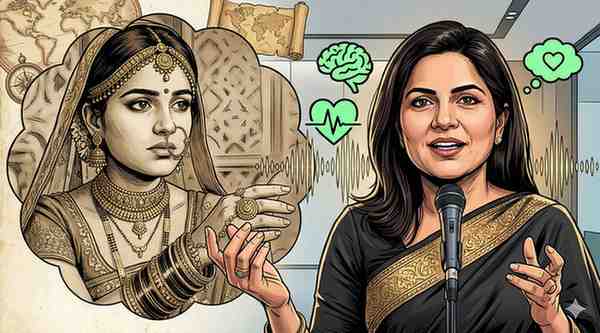
Mumbai, March 2026 — In a candid and deeply personal conversation, Neerja Birla, a prominent mental health advocate and wife of industrialist Kumar Mangalam Birla, shared her life’s journey—from the challenges of marrying into a massive legacy at age 18 to her own silent battle with postpartum depression. Her story is one of transformation, evolving from a teenager navigating high-society expectations to a leader dismantling the stigma surrounding mental health in India.
The 18-Year-Old Bride: Navigating a “Large Legacy”
Reflecting on her early years, Birla revealed she was engaged at 16 and married by 18. The transition from a teenager driving herself to college in jeans and a T-shirt to a bride expected to attend classes in a saree was “very difficult”. She admitted that the pressure eventually became overwhelming, leading her to drop out of college temporarily.
“I was too hard on myself back then,” she recalled, noting that she simply “flowed with life” in her naivety, which perhaps helped her navigate the daunting shift into one of India’s most prominent families.
The Turning Point: Postpartum Depression and Advocacy
Birla’s 10-year journey into mental health advocacy was sparked by her own “lived experiences.” At age 23, following the birth of her first child, she grappled with postpartum depression. At the time, there was no vocabulary to articulate her pain, leading to immense isolation and guilt.
Years later, seeing her daughter struggle with her own mental health became the ultimate catalyst for founding Mpower. Birla emphasized that even for those with wealth and education, awareness remains a hurdle; she noted that having her feelings “validated” and putting a “label” to the condition helped her navigate it far better during subsequent pregnancies.
Breaking Myths: Legacy, Men, and “Endurance”
Birla took aim at several societal myths that prevent people from seeking help:
- The “Legacy” Myth: She argued against the assumption that wealth shields one from emotional struggle, stating that personal battles should never be trivialized based on material resources.
- The “Strong Man” Myth: Addressing men’s mental health, she noted that 78% of callers to their helpline are men. This proves that the desire for support exists, even if the fear of appearing “weak” keeps it hidden in public.
- Glorified Endurance: She criticized the cultural tendency to glorify “enduring quietly,” which is often normalized as a way to build strength but actually deepens the crisis.
A Mother of Six: Building Independent Identities
As a parent of three children and three dogs, Birla spoke about her conscious decision to let her children carve their own paths. From her daughter Ananya’s music career to her son Aryaman’s time as a cricketer, she believes building a unique identity is crucial for self-esteem when coming from a powerful legacy.
She noted that while the family business is a safety net, her children’s individual ventures—including her daughter Advaitesha’s social enterprise for menstrual health—allow them to stand on their own feet.
Bottom Line
Neerja Birla’s message to India is clear: mental health is the “fabric of our being”. Whether in the boardroom or the living room, empathy and vulnerability are not signs of weakness but essential tools for leadership. As India navigates a youthful, entrepreneurial era, her advocacy serves as a reminder that the strongest “resilience” comes from acknowledging one’s struggles, not reasoning them away.
Leave a Reply