
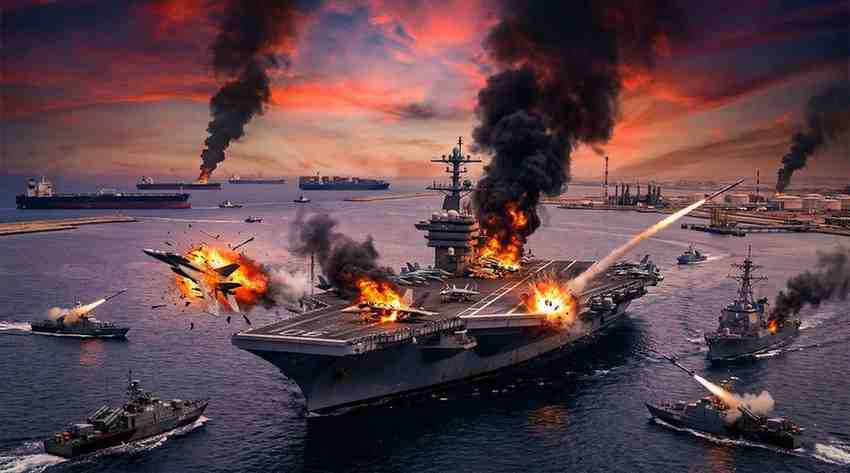
Tehran/Washington D.C., March 2026 — Tensions in West Asia have reached a perilous new peak as Iran’s Islamic Revolutionary Guard Corps (IRGC) claims to have successfully struck a U.S. F-18 aircraft and forced the USS Abraham Lincoln carrier group to reposition following a barrage of cruise missiles. While the U.S. has officially rejected these claims, the announcement marks the “79th wave” of Iran’s ongoing military operations in the region.
The Air and Sea Standoff
According to Iranian military broadcasts, a new integrated air defense system near Chabahar successfully targeted and “hit” an American F-18 fighter jet. Simultaneously, the IRGC claims its coastal batteries fired “Ghadar” cruise missiles at the USS Abraham Lincoln naval group, purportedly forcing the carrier to change its strategic position in the Gulf.
The strikes are part of a broader offensive labeled “Operation Promise of the True Word 4,” which Iran asserts has hit over 70 points within “occupied territories,” including strategic locations like Haifa and Dimona. The IRGC utilized a sophisticated mix of liquid and solid-fuel precision missiles—including the Khorramshahr-4 and Qiam—alongside “destruction drones” to target U.S. and Israeli military hubs.
A Dual-Chokepoint Threat: The Red Sea Factor
The conflict is no longer confined to the Persian Gulf. Intelligence reports suggest that Yemen’s Ansarullah movement (the Houthis) is preparing to join Iran’s efforts by asserting control over the Bab-el-Mandeb Strait.
This move follows the recent sinking of two Greek-operated cargo vessels, the Eternity Sea and the Magic Seas, both of which were targeted by Houthi sea drones and rocket-propelled grenades in the Red Sea. Analysts warn that a coordinated blockade of both the Strait of Hormuz and the Bab-el-Mandeb would effectively choke the world’s most vital maritime arteries for oil and global trade.
Economic and Military Impact
The IRGC claims that massive financial and human losses at American bases in Erbil and elsewhere are being concealed by “news censorship”. Iranian forces reportedly targeted a support and command center near Erbil airport, which serves as a critical hub for U.S. military equipment and systems maintenance.
Bottom Line
As Iran continues its waves of missile and drone strikes, the regional power struggle has evolved into a strategic siege of global shipping lanes. With the U.S. Navy maintaining its presence despite Iranian claims of “repositioning,” the risk of a direct, large-scale naval confrontation has never been higher.
Leave a Reply